Gutter Problems We See Most in Leander, Cedar Park, and Round Rock
Plenox Solutions | Leander, TX | Roofing and gutter contractor serving Williamson County
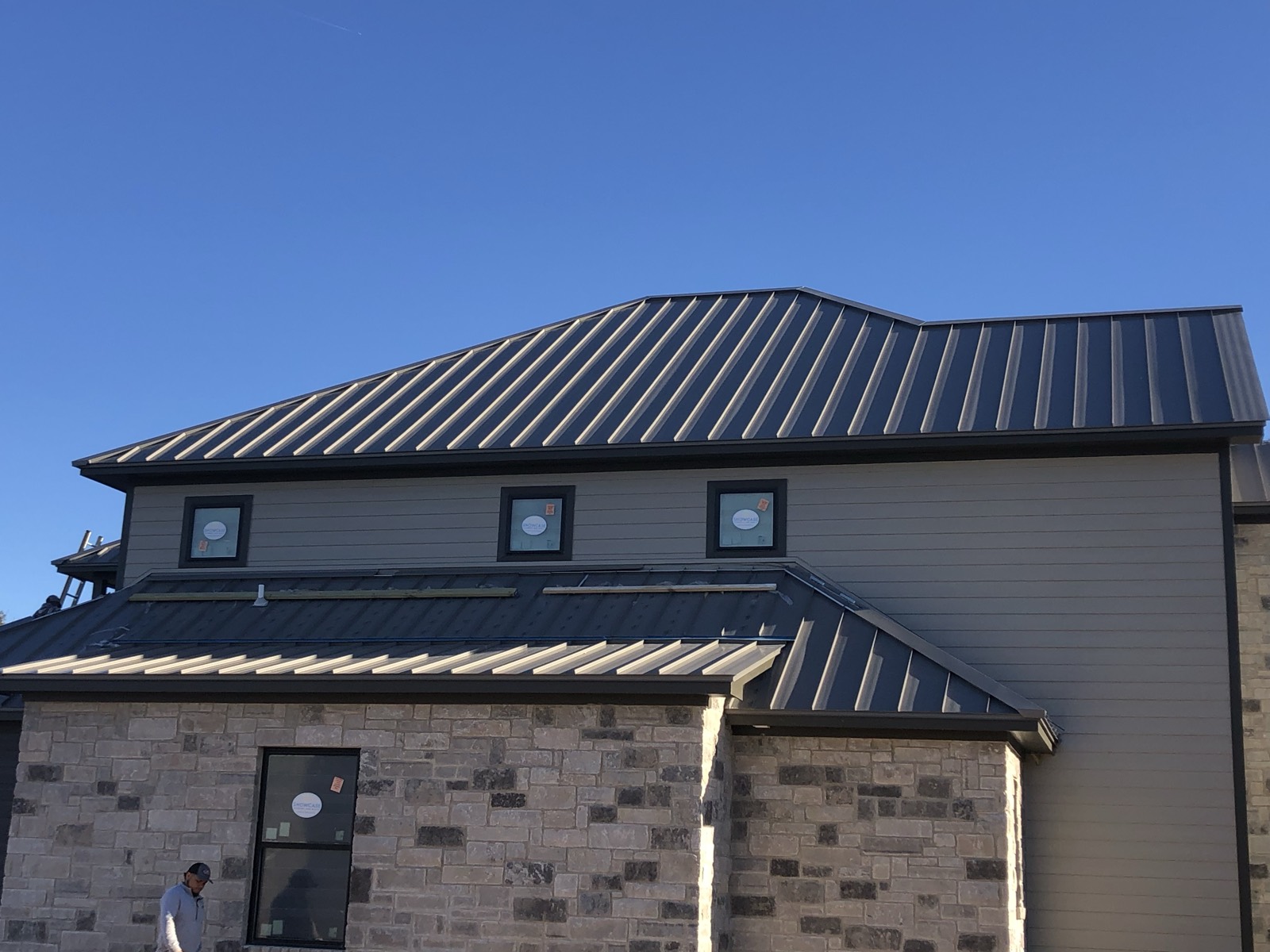
Most homeowners do not think about gutters until something goes wrong. By then, the water damage has already started. We get on a lot of roofs in Leander, Cedar Park, and Round Rock in the course of storm inspections and re-roofing jobs, and the gutter situation on most homes gives us a clear picture of what fails most often in this part of Central Texas. Here is what we actually see.
Gutters Pulling Away from the Fascia
This is the most common gutter problem we see in Williamson County, and it shows up most often on homes from the 1990s and early 2000s in established neighborhoods in Cedar Park and Round Rock. The gutters are original to the house, hung with spike-and-ferrule fasteners that were the standard at the time. Those spikes pull out of the fascia as the wood ages and seasonal expansion and contraction cycles work the fastener loose over years.
A gutter that has pulled away from the fascia is no longer draining correctly. Water runs behind the gutter rather than into it, soaking the fascia board and the soffit below. Rotten fascia boards are a direct consequence of this failure mode left unaddressed. The repair for spike-and-ferrule failure is replacement with hex-head screw hangers set into solid wood, or in cases where the fascia has rotted, fascia board replacement followed by reguttering.
Overflow During Heavy Rain
Central Texas gets intense rain in bursts rather than steady light rain. When a summer storm drops an inch in twenty minutes, gutters that are undersized or have too few downspouts cannot move the water volume fast enough. The overflow runs over the gutter edge and concentrates at the foundation line rather than being directed away from the house. Over time, foundation saturation is the result.
On production-built homes in newer Round Rock and Leander developments, the standard was often five-inch gutters with downspouts at each end of the run. For homes with steep roofs or large drainage areas, this configuration underperforms. The fix is either adding intermediate downspouts to shorten the run, upgrading to six-inch gutters, or both. We assess the drainage area and recommend the correct configuration rather than defaulting to the builder spec.
“Gutter neglect rarely costs you a gutter. It costs you the fascia behind it, the soffit below it, and eventually the foundation the water pools against.”
Standing Water in Gutters
Gutters require a slight pitch toward the downspout, typically about one quarter inch of drop per ten feet of run. Gutters hung level or sagging in the middle accumulate standing water. In Central Texas summers, standing water in a gutter is a mosquito breeding environment. It also accelerates corrosion of aluminum gutters from the inside and contributes to joint sealant degradation on sectional systems.
Re-pitching a gutter run requires re-hanging it, which is essentially a reinstallation. If the gutters are original and showing other signs of age, the repair cost often approaches replacement cost, and new seamless gutters eliminate the sectional seam failure points at the same time.
Storm Damage to Gutters
Hail dents gutters. Significant hail, the kind that makes shingle granules migrate to the downspout discharge point, also leaves visible circular dents in aluminum gutters. On its own, gutter denting does not affect function. But hail events that dent gutters typically also damage shingles, and the gutter inspection is part of the overall storm damage assessment. Damaged gutters are included in a storm insurance claim when they show clear impact evidence.
Wind also damages gutters. A section that catches wind becomes a lever arm against the fascia attachment points. After a wind event, look for gutter runs that are at a visibly different angle than they were before the storm.
K-Style vs Half-Round Gutters on Texas Homes
Almost every home we work on in Leander, Cedar Park, and Round Rock has K-style gutters, and for production-built Central Texas housing that is the right default. K-style has a flat back that screws straight to the fascia, a decorative front profile that reads as crown molding from the ground, and a cross-section that carries more water than a half-round of the same nominal width. That capacity matters here, where the rain comes in short heavy bursts rather than steady drizzle. A five-inch K-style gutter moves noticeably more volume than a five-inch half-round, which is part of why builders standardized on it.
Half-round gutters are a rounded trough that usually hangs from external brackets. They are mostly a fit for older or architecturally specific homes, copper installations, and properties where an HOA or a homeowner wants the traditional look. They self-clean a little better because debris does not catch in an inside corner, but they hold less water and cost more to install. For the typical Williamson County home dealing with overflow and fascia pull-away, the answer is rarely a switch to half-round. It is correctly sized and pitched K-style, hung with screw hangers into solid fascia, with enough downspouts for the drainage area. We spec the profile to the house rather than to a preference, and on most homes in this market that means seamless six-inch K-style on the steep or large-drainage elevations.
If your gutters are pulling away, overflowing, or came through a recent hail storm, call Plenox Solutions for an assessment. We serve Leander, Cedar Park, Round Rock, Georgetown, and Williamson County.
Call (432) 288-5562 Schedule AssessmentWhy the Drainage Point Matters as Much as the Gutter
A gutter that drains correctly into the wrong place is still a problem. We see a lot of homes in Williamson County where the gutters and downspouts are fine, but the downspout dumps water two feet from the foundation and the lot grades back toward the house. Central Texas sits on expansive clay soil. That clay swells when it gets wet and shrinks when it dries out, and a downspout that concentrates roof water against one corner of the slab creates exactly the kind of localized wet-dry cycling that moves a foundation over time. Foundation movement shows up later as cracked drywall, sticking doors, and separated brick veneer, and the cost of that repair dwarfs the cost of the roof water that caused it.
The fix is usually simple once the gutters themselves are sound. Downspout extensions, splash blocks pitched away from the house, or in some cases buried drain lines that carry the water out past the foundation zone. When we replace or repair a gutter system, we look at where the water actually ends up, not just whether the trough is draining. A correct gutter system moves roof water away from the structure entirely, which is the whole point of having gutters in the first place. Getting the trough right and ignoring the discharge point solves half the problem.
A Word on Gutter Guards
Guards get sold hard in this market, and the honest answer is that they earn their cost on some houses and not on others. A home in an established Cedar Park neighborhood with mature live oaks dropping leaves and catkins into the troughs twice a year is a genuine candidate: a quality micro-mesh guard keeps the debris load out and stretches cleaning from twice a year to occasional rinsing. A newer Leander home with no tree cover within fifty feet gains very little from the same product. The failure mode to avoid is the cheap snap-in screen, which collects granules and seed pods on top, mats over, and turns the gutter into a covered planter that overflows in the first hard rain. If guards make sense for your lot, they should be installed on correctly pitched, solidly hung gutters, because covering a failing system locks the problems underneath where nobody sees them.
When to Repair vs Replace
The right answer depends on the overall age and condition of the gutter system, the nature of the failure, and whether the fascia behind the gutters is intact. A single failed end cap or a minor seam leak on an otherwise sound system is a repair. Gutters that are pulling away at multiple points, are heavily corroded, have numerous failing seams, or sit on rotten fascia boards are candidates for replacement. We give a straight assessment when we visit and will tell you the right answer, not the one that produces the larger job. See our gutter replacement page and gutter repair page for more, or call (432) 288-5562. Our contact page also works.