
Storm-Damage Roof Restoration for Pflugerville
Hail and wind damage handled straight through: inspection, tarping, the paperwork your carrier needs, then the finished roof. Lifetime workmanship warranty. Six years of weatherproofing included. Our shop is 25 minutes west in Leander.
When a Cell Tracks the 130 Corridor
Most springs, somewhere between April and June, a line of storms drops out of the north and runs the SH-130 corridor. Pflugerville sits low and open on the blackland prairie edge, with little standing between the city and whatever the sky throws. Some years the hail is pea-sized and nobody thinks twice. Other years the stones bruise every shingle on a street in twenty minutes. Storm restoration is what happens after that: a process running from a proper inspection through your carrier’s paperwork to a roof that is whole again. We handle the whole chain so you are not stuck translating between a roofer and an insurance company.
What We Actually Look At Up There
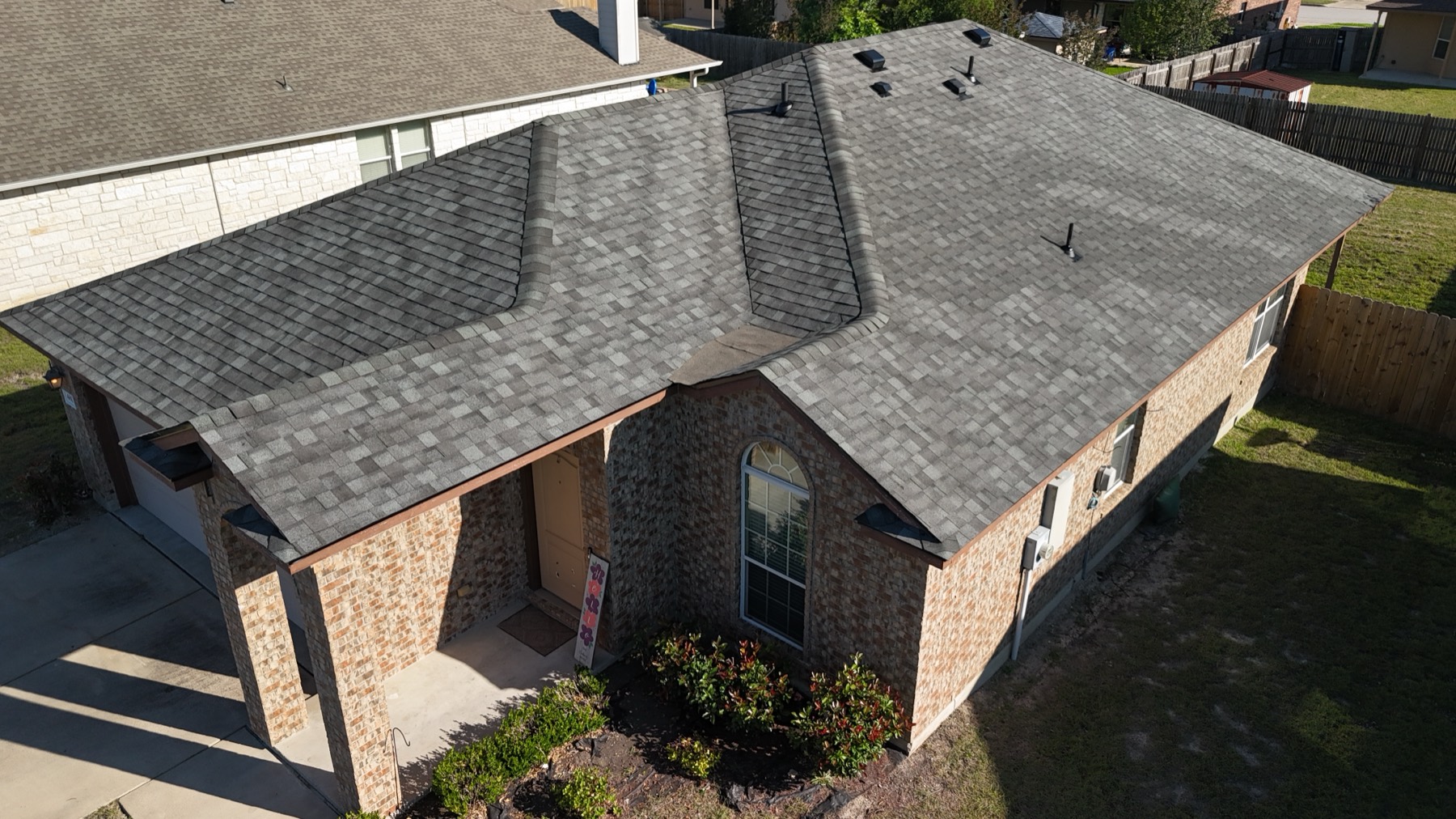
An inspection that holds up with an adjuster is more than a walk around the yard, and the order matters. We start with a drone pass so there is an aerial record of every slope before anyone sets foot up there. Then we check the soft metals first, because vents, pipe boots, drip edge, and gutter faces tell the honest story about how big the stones were. From there we move onto the shingle field, chalk test squares on each slope, and count the bruises so the damage reads as a density across the roof instead of one dramatic photo. Last, we go into the attic and look for daylight, staining, or fresh moisture at the decking.
- Aerial pass. The whole roof documented before the physical inspection starts.
- Soft metals. Dented vents, boots, flashing, and gutter faces confirm damaging hail hit your address, not the one two streets over.
- Test squares. Marked-off sections on each slope that quantify the bruising the way a carrier expects to see it.
- Attic check. Water intrusion a surface-only look would miss entirely.
How Hail and Wind Wear a Pflugerville Roof
Hail and wind do different damage, and knowing which you took matters when the scope of loss gets written. Hail bruises the asphalt mat underneath the granules, showing as a round impact mark with the granules knocked loose at the center. Then the sun goes to work on that exposed spot and it wears through faster than anywhere else on the roof. That is why hail that looked like nothing in April becomes an active drip two or three springs later, long after the filing window closed. Wind is different. It gets under the leading edge of a tab, snaps the sealant strip, and lifts the shingle so it stops shedding water. On the open ground toward the prairie north of FM 685, where no tree line breaks the gusts, wind can strip whole courses without a single shingle hitting the lawn.
The other thing about this town is that the roofs came in waves. The production builds out around Falcon Pointe, Blackhawk, and Avalon went up fast and close together, so whole streets are running the same shingle from the same era. One storm ages the entire block at once. The older streets near Pecan and downtown have mature trees that shelter some slopes and drop limbs on others. We read the roof in front of us before we decide what the storm did.
About the Trucks That Show Up After
Within about three days of any real hail event here, the door-knockers arrive. Out-of-state plates, clipboards, and a confident story about how the whole neighborhood is getting a new roof. Some will offer to cover your deductible. In Texas that is insurance fraud, and a company willing to do it is either planning to pad the claim or cut corners on your decking. They will also be four states away by the time the first leak shows up. We are twenty-five minutes west in Leander and we work Pflugerville year round, so we are still reachable after the check clears.
Tarping and Drying the Building In
The first hours after a storm are about stopping further loss, not about paperwork. When wind or a fallen limb opens a roof, water keeps coming in with every rain until that opening is closed, and once insulation and drywall get wet the damage compounds fast. We prioritize those calls, get a real tarp fastened over the opening within days, and photograph the damage before and after we cover it. That record matters. Mitigation is usually reimbursable, and your carrier wants evidence you took reasonable steps to prevent further loss.
Once the building is dried in, everything else can move at a sane pace. There is no good reason to push somebody into signing a restoration contract while they are still sweeping up hail, so we separate the emergency step from the restoration decision on purpose. Protect first, decide second. We wanted to do it the right way instead of trying to make a quick nickel off of homeowners.
How the Claim Walk-Through Goes
Here is the part people get told wrong, so we say it plainly: the adjuster writes the scope of loss, not us. Your carrier sends someone out, they inspect the roof, and what they put in writing is what the claim covers. Our job is to be up there with our own documentation so the conversation is about the actual damage on the actual slopes. Adjusters carry a heavy load after a regional event and they move fast, sometimes under twenty minutes on a full roof. Having someone there who knows which back slope took the worst of it changes what ends up on the paperwork.
If that scope leaves off something real, we file a supplement with photos showing why. It is a normal part of the process. What we will not do is invent damage or pile on line items to fatten an invoice. A supplement is for something genuinely missed, and if nothing was missed, we do not file one.
Full Restoration or a Repair
Not every storm calls for a new roof, and we will tell you when it does not. Damage confined to one slope on an otherwise sound roof is a repair, and we would rather do the repair. It changes when the bruising is spread across every slope, or the roof was already near the end of its life and the storm finished it. Then a patch is money spent twice, and restoration means taking it to bare decking, replacing rotted wood, laying fresh underlayment, and putting the assembly back as one system.
Matching is the wrinkle nobody mentions until it comes up. Shingle lines get discontinued, color drifts between production batches, and a decade of Texas sun has already faded what is up there, so a fresh bundle rarely blends invisibly on an older roof. When we cannot get a reasonable match on a partial repair, we say so up front rather than handing you a two-tone slope facing the street.
What the Timeline Really Looks Like
After a big regional event, everything stacks up. Adjusters are booked, suppliers run short on the popular colors, and every crew in the metro is working a backlog. Work that would take a couple of weeks in a quiet month can stretch past that when the whole corridor got hit the same afternoon. The tear-off and install is usually a day, sometimes two or three on a large or steep roof. The waiting happens before that, in the claim and the material. We tell you where you stand and update you when it moves.
The Plenox Approach
We stay on the job from the first look through completion, and we come back to weatherproof the roof once a year for six years afterward. If we get up there and the roof is sound, we tell you straight and you owe us nothing for the visit. Every restoration carries our lifetime workmanship warranty. See our Pflugerville roofing page, our metal roofing and gutter replacement work in town, or finished roofs in our project gallery. Call (432) 288-5562 or reach us through our contact page for a free roof review.
Pflugerville Storm Restoration FAQ
Should I call a roofer or my insurance company first?
Call a roofer first. Adjusters work a checklist and move quickly, especially after a storm that hit the whole corridor. Someone who has already inspected the full surface can walk the damage points with them so nothing gets left off the scope of loss.
Do you tarp roofs in Pflugerville after hours?
Yes. If a storm opened your roof, we get a proper tarp fastened over it within days and photograph the opening before and after. Mitigation like that is typically reimbursable, and the photos show your carrier you moved to prevent further loss. Call (432) 288-5562.
What if you get up there and find nothing?
Then we tell you the roof is fine and you owe us nothing for the look. We are not going to manufacture damage to start a claim. If your roof came through sound, the honest answer is worth more to us than a job we should not be doing.
Who decides what my insurance pays for?
Your carrier’s adjuster does. They inspect the roof and write the scope of loss, and that document is what the claim covers. We are up there with our own photos so the discussion is grounded in what is on your slopes. If something real gets left off, we file a supplement with documentation to back it.
Can you match my existing shingles on a partial repair?
Sometimes, and sometimes not. Shingle lines get discontinued, color varies between batches, and years of sun have faded what is on your roof. If we cannot get a reasonable match, we say so before we start rather than after.
Storm Restoration for Pflugerville
Inspection, tarping, claim support, and full restoration under one lifetime warranty. Call us after the storm.