
Roof Ventilation in Leander
Attic ventilation, ridge vents and Lomanco vents designed and installed right, so your roof breathes, your attic runs cooler, and the shingles above it reach their full life. Based in Leander, working across TX.
A roof that breathes lasts longer
Ventilation is the part of a roof nobody talks about until it costs them. A Central Texas attic with no air moving through it climbs past 140 degrees in summer, bakes the underside of the deck, cooks the life out of the shingles, and drives the cooling bill up while it does it. In winter that same trapped air holds moisture, which rots decking and grows mold you never see.
We design and install attic ventilation as its own job and as part of every roof we put on. We are Lomanco-certified in attic ventilation concepts and design, which means we size the intake and exhaust to the actual square footage and pitch of your attic instead of nailing on a couple of vents and calling it done. Get the balance wrong and the roof either suffocates or pulls conditioned air straight out of the house.
Tell us what your attic is doing now and you get a free roof quote with the vent type, the count and the balanced intake-to-exhaust ratio spelled out in plain language.

Continuous ridge vent, finished install
How we set up your ventilation
We get in the attic first
Before we touch the roof we go up into the attic and read what is actually happening: temperature, moisture stains on the decking, blocked soffits, mismatched vents fighting each other. You get a straight picture of why the attic runs hot, with photos, not a sales pitch.
We size intake and exhaust to balance
Ventilation only works when air comes in low and leaves high in the right amounts. We calculate the net free area your attic needs to our Lomanco-certified design, then match soffit or eave intake to ridge or vent exhaust so the system pulls evenly across the whole attic, not just one corner.
We install the vents and clear the intake
We cut and set continuous ridge vents, static vents, turbines or solar attic fans to fit your roof, flash every penetration so it stays watertight, and open up any soffit intake that insulation or paint had sealed shut. Exhaust without intake is just a hole in the roof, so we make sure the low side can actually feed it.
We verify airflow and hand you the warranty
We confirm the attic is moving air the way the design says it should, sweep the property with a magnet for stray fasteners, and hand you the lifetime workmanship warranty plus six years of annual weatherproofing on the vent flashings and seals.
Ridge vents, Lomanco vents and what fits your roof
There is no single best vent, only the right one for your roof shape, your attic and your budget. A continuous ridge vent is the system we reach for most on homes with a clean ridge line. It runs the full length of the peak under a cap of matching shingles, so it moves a lot of air across the whole attic, it disappears into the roof instead of dotting it with humps, and it has no motor to fail. Paired with open soffit intake along the eaves, a ridge vent sets up the steady low-to-high airflow that a Texas attic needs, and it does it on its own with no power and nothing to maintain.
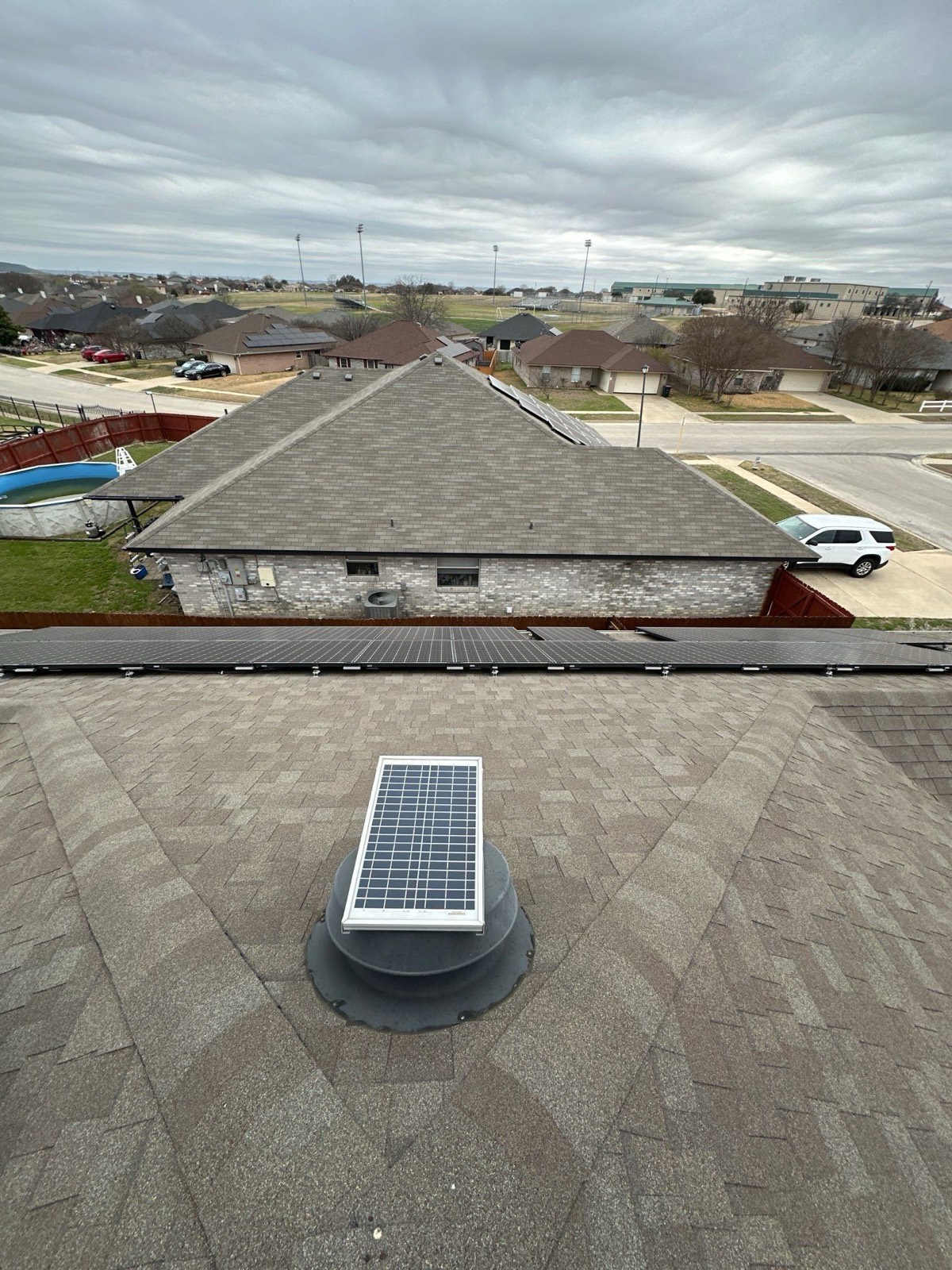
Where a ridge vent does not fit, the roof has a short or broken ridge, a hipped shape, or a low slope, we turn to Lomanco vents, the brand we are certified in. Lomanco makes static box vents, turbine vents and balanced exhaust units that we can place to ventilate sections of an attic the ridge cannot reach, and their design tools are exactly what our Lomanco certification trains us to use to get the math right. On a deep attic that runs hot even with passive venting, a solar-powered attic fan adds active exhaust during the worst of the afternoon heat without adding a watt to your electric bill.
Exhaust without intake is just a hole in the roof.
Plenox Solutions, on balanced attic ventilationThe piece most roofers get wrong is balance. You can have plenty of exhaust and still cook the attic if the intake is choked off, and stacking too many exhaust vents of different kinds makes them short-circuit and pull air from each other instead of from the soffits. When you call, we count and measure what you already have, tell you honestly whether it is working, and lay out the cleanest fix, which is exactly the do-it-right approach we built this company on instead of upselling vents you do not need. Good ventilation also protects the rest of the work we do, so it ties straight into our metal roofing and shingle roof repair jobs, and the same airflow that saves a roof from baking is what keeps a deck dry after the storm restoration crew rebuilds it.
Built right, then stood behind
Ventilation is the kind of work where a shortcut hides for years and then shows up as a rotted deck or a roof that aged out early. That is why we treat it as engineering, not guesswork. Plenox is licensed, insured and OSHA-certified, so the cutting and the rooftop work happen safely and to code, not in a rush by whoever was free. Every attic we vent follows our Lomanco-certified design, because the brand we install certified us to size and balance the system instead of eyeballing it.
Every install carries a lifetime workmanship warranty, so the quality of the work is covered for as long as you own the roof. On top of that we include six years of weatherproofing done annually, where we come back, check the vent flashings, seals and intake, and reseal anything that has moved before water finds it. That is how a relationship outlasts the install, and it is the part most roofers skip the moment the check clears. Our Lomanco certification is one of the credentials you can read more about on our about and contact side.
Roof ventilation questions
Straight answers about heat, vent types, cost and warranty. If yours is not here, call (432) 288-5562 or send it through our contact page.
How do I know my attic is under-ventilated?
The tells are an attic that is brutally hot in summer, upstairs rooms that never cool down, ice or frost on the underside of the deck in winter, dark moisture stains on the rafters, and shingles that curl or wear out years early. If you are seeing any of those, the attic is not moving enough air. We can go up, read it, and tell you what is happening before you spend a dollar.
What is the difference between a ridge vent and Lomanco vents?
A ridge vent runs continuously along the peak of the roof and ventilates the whole attic passively, which makes it the cleanest choice on a home with a long straight ridge. Lomanco vents are box vents, turbines and balanced exhaust units we place where a ridge vent cannot reach, on hipped, short-ridge or low-slope roofs. We are Lomanco-certified, so we size and balance either system to your specific attic instead of guessing.
Will better ventilation actually lower my cooling bill?
It helps. When an attic is venting properly it stops trapping a 140-plus-degree heat load directly over your ceilings, so your air conditioner is not fighting that wall of heat all afternoon. It is not a magic fix on its own, it works alongside good insulation, but a balanced vent system takes real load off the system and helps the upstairs stay comfortable.
Why does intake matter as much as exhaust?
Ventilation is air in low, air out high. If you add ridge or box vents for exhaust but the soffit intake along the eaves is painted over, blocked by insulation or missing, the exhaust has nothing to pull from and the attic stays hot. A balanced system is the whole point of our Lomanco-certified design, and clearing intake is part of every ventilation job we do.
Do solar attic fans really work in Texas?
On a deep attic that runs hot even with passive venting, a solar-powered attic fan adds active exhaust during the hottest part of the day and runs on the sun, so it costs nothing to operate. It is not the right answer for every roof, sometimes balancing the passive system fixes the problem, but where it fits it pulls real heat out without adding to your electric bill.
How far does Plenox travel for ventilation work?
We are based in Leander, TX and cover the Austin metro plus jobs statewide across TX. If you are not sure you are in range, reach out through our contact page or call and we will tell you straight.
Cool the attic, save the roof
Tell us how hot your attic runs and what your roof is doing. We will go up, read the airflow, and put a clear number on the fix. Your free roof quote costs nothing and you are under no obligation. See finished work in our project gallery.
Serving Leander and statewide TX
We design and install roof ventilation across the Austin metro and out across Texas from our Leander shop. A few of the cities we work in: