Metal Roofing in Hutto
Standing-seam and exposed-fastener metal roofing installed by a licensed and insured, OSHA-certified crew working in our home county. Whether your house went up last year or has been off US 79 for decades, we will tell you honestly whether metal is the right call before anyone quotes you anything.
Two Kinds of Roofs, One Town
Hutto is really two housing markets sharing a zip code, and metal answers a different question in each one. On the newer side, whole streets went up at once and every house on the block got the same composition roof on the same day, which means they will all reach the end of their service life on roughly the same schedule. Owners out there are usually thinking ahead: they have watched the neighborhood age together and they would rather step off that cycle before it starts than replace the same roof three times.
Then there is the older stock closer to the original center of town and along the county roads, houses that have already been through two or three composition roofs and a few serious hail seasons. Those owners are not speculating about anything. They know exactly what a Central Texas spring does to asphalt because they have paid for it, more than once, and they want to know what a metal roof would change. Both conversations are legitimate and they call for different answers, so we do not walk into either one with a script. We get on the roof, look at what is actually there, and talk it through.
Standing Seam Versus Exposed Fastener
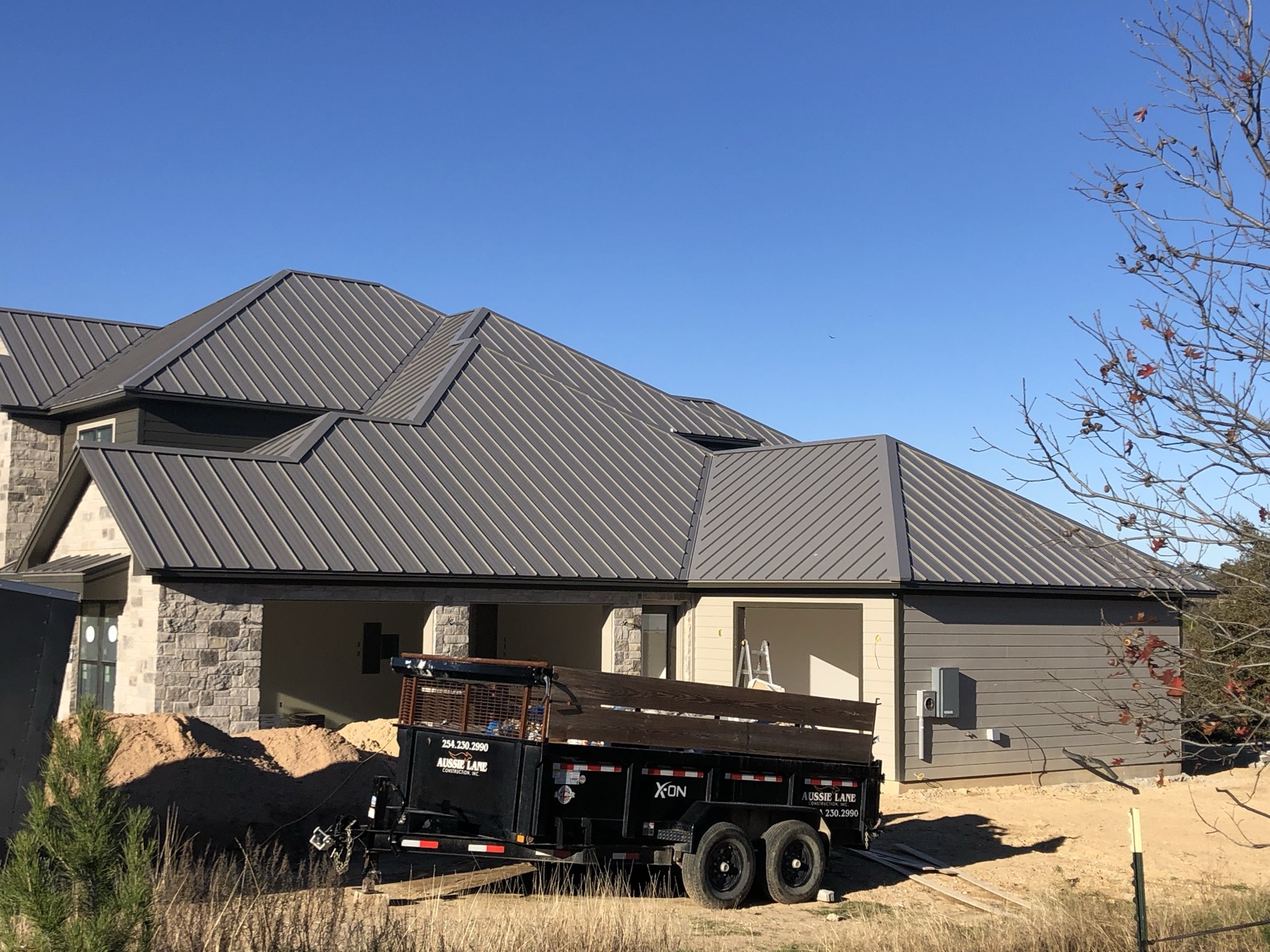
Almost every metal roofing decision in Hutto comes down to which of two panel systems belongs on your building, and the difference is not cosmetic. On a standing-seam roof the fasteners are hidden underneath the panels and the sheets lock together at raised vertical seams, so nothing punches through the flat of the roof where water runs. The panels are clipped so they can slide as they expand and contract. That is the system we put on houses, and it is the one that clears architectural review in the newer subdivisions without much argument.
Exposed-fastener panels are screwed straight through the face of the metal into the framing, with a sealing washer under every screw head. They cost meaningfully less to install and they are the right tool for a shop, a barn, a carport, a covered patio, or a straightforward light commercial building. What you accept in exchange is maintenance: those washers age, and screws work loose over the years as the panel moves under them, so an exposed-fastener roof wants a set of eyes on it periodically. There is nothing wrong with that. It is only wrong when somebody sells you one without mentioning it.
- Standing seam. Concealed fasteners, clipped for movement, the default for Hutto homes and the profile subdivision boards accept.
- Exposed-fastener panels. Face-screwed and economical, well suited to shops, outbuildings, and light commercial roofs that get looked at now and then.
- Metal over existing shingles. Possible on some buildings and a genuine savings when it works, but only after we have checked the decking and how the assembly will breathe.
What Hail Actually Does to a Metal Panel
Hutto sits in hail country, and the storms that roll across Williamson County in spring are the reason most roofing conversations start here. So it is worth being precise about metal, because the marketing around it tends to overstate the case. A metal roof is not hail-proof. A stone large enough will leave a dent in a panel, and if it is a big cell you may end up with a roof that looks stippled from a certain angle in a certain light.
What that dent does not do is compromise the roof. A composition shingle sheds granules when it is struck, and those granules are the sunscreen for the asphalt mat underneath. Once they are gone the mat cooks, and the roof that looked fine after the storm fails a year or two later, which is why hail damage on shingles is so often argued about with an adjuster. A metal panel has no granules to lose and no mat to expose. It gets dented and keeps shedding water. That is the honest distinction: dents on metal are usually an appearance question, while granule loss on asphalt is a countdown. If your roof does take a hard hit, our storm restoration crew in Hutto can document it properly.
Texas Heat, Panel Movement, and Attic Temperature
Metal moves. A roof surface in this part of the state can swing well over a hundred degrees between a January night and a July afternoon, and steel grows and shrinks with every bit of that. This is the single most important thing to understand about a metal roof, because it drives the whole installation. Panels have to be sized, clipped, and flashed so they are free to slide. Every trim detail, every penetration, every valley has to accommodate that movement instead of pinning the metal in place.
When it is done right you never think about it again. When it is done wrong, the roof fights itself. Fasteners work loose, seams take stress they were never meant to carry, and leaks start showing up at the details while the wide flat panels still look perfect from the curb. That failure pattern is the most common thing we are called out to fix on metal roofs in this area, and it is almost never the material’s fault. Reflectivity is the other half of the heat story: a lighter or reflective finish throws off a real share of the summer load instead of driving it down into your attic, which is where we also look at whether intake and exhaust are balanced rather than assuming the builder got it right.
Oil Canning, Gauge, and Living With the Look
Two things about appearance nobody tells homeowners until after the roof is on. The first is oil canning, the gentle waviness you can sometimes see across a wide flat run of metal in raking light. It is a normal characteristic of formed sheet metal, not a defect and not a failure, but if you did not know it existed you will notice it on the first evening the sun hits your roof sideways and wonder what went wrong. Nothing did.
The second is gauge, the thickness of the steel. Lighter gauge is cheaper and it will show a hail dent or an oil-canning ripple more readily across a big open plane. Heavier gauge costs more and stays flatter through decades of expansion and contraction. Neither is universally correct and the right answer depends on your roof’s planes, its slope, and how much of it faces the afternoon sun. In the newer Hutto subdivisions there is a third factor: your HOA or architectural guidelines may have something to say about profile and color. Send us your covenants and we will tell you what will clear before you fall in love with a color chip.
How We Work in Hutto
Metal is a twenty-year decision and we quote it that way. We would rather be the people you call first the next time something happens up there. Every roof carries a lifetime workmanship warranty, and we come back once a year for six years to handle the included weatherproofing ourselves instead of leaving it to you to remember. See our full metal roofing page and browse completed projects. If the roof you have now needs attention before any of this, start with shingle roof repair in Hutto. We also handle gutter replacement and commercial roofing around town, and everything we do locally is listed on the Hutto roofing page. Call (432) 288-5562 or contact us to set up a free roof review.
Hutto Metal Roofing Questions
Is a metal roof loud when it rains?
This is the myth we hear most, and it comes from people remembering a barn or a carport where the panels were screwed straight to open framing with nothing underneath. Your house is not that. A residential metal roof goes over solid decking and underlayment, with insulation and a ceiling below that, and most owners tell us it sounds about the same as the roof they had before.
How much longer will metal last than the shingles I have now?
Considerably, and that is the entire financial argument for it. Composition roofing in Central Texas heat and hail is a recurring expense you meet again roughly every decade, with a tear-off and disposal bill each time. A properly installed metal roof is meant to carry you through several of those cycles. Look at the cost across the life of the roof rather than the day you sign.
Will my subdivision’s HOA approve metal?
Standing seam usually clears without much trouble, because its profile and color range read close enough to conventional roofing that boards rarely object. Exposed-fastener panels are the ones that draw appearance complaints in newer neighborhoods. Send us your architectural guidelines and we will tell you what will pass before you pick anything. Call (432) 288-5562.
What is the wavy look I see on some metal roofs?
That is oil canning, a slight waviness visible across wide flat panels in certain light. It is an inherent characteristic of formed sheet metal, not a defect, and it has no effect on how the roof performs. Panel width, steel gauge, and how flat the deck is underneath all influence how noticeable it is, so we discuss it before installation rather than after.
Can you install metal over my existing shingle roof?
Sometimes, and we will not know until we are up there. We check the decking for rot and flex, count how many layers are already on, and look at whether the assembly can still breathe once it is covered. If it works you save the tear-off and disposal. If it does not, we say so, because covering a bad deck only hides a problem you paid to bury.
Why do some metal roofs in this area fail early?
The installation, almost every time, not the metal. Panels, clips, flashing, and trim all have to let the roof slide as it heats and cools through a Texas year. Pin it down and fasteners loosen and seams take stress until leaks appear at the details while the flat panels still look fine. The bad ones usually trace back to a crew that mostly hangs shingles and takes an occasional metal job.
Let Us Look at Your Hutto Roof
Licensed and insured, OSHA certified, lifetime workmanship warranty on every roof we build. Call us or ask for a free roof review and we will tell you straight whether metal makes sense on your house.