Commercial Roofing in Hutto
Low-slope roof work for Hutto businesses, from the warehouse and light industrial buildings along US 79 to the retail and office space filling in behind them. Licensed and insured, with an OSHA-certified crew and a lifetime workmanship warranty on every job.
What Sits Above a Hutto Tenant Space
Hutto grew up along US 79, and the commercial building stock followed the highway. Warehouse and light industrial shells on the outer edges, retail and service space closer in, and a steady stream of new construction pushing out behind both. Nearly all of it is low-slope. A flat roof is not actually flat, it is built with a shallow pitch that is supposed to move water toward a drain, and how well that shallow pitch survives twenty years of Central Texas weather is most of the story on any building we get called to.
What makes a commercial roof different from a house roof is not the size, it is the failure pattern. A shingle roof tells you it is failing. Something blows off, a stain appears under it, and the path from the hole to the damage is short and vertical. A low-slope membrane does not work that way. Water finds a split seam or a lifted flashing, gets under the sheet, and then travels laterally across the insulation until it finds a deck fastener or a joint to drop through. The wet ceiling tile inside the space can be a long way from the actual breach.
That gap between where water enters and where it lands is the single reason commercial owners in Hutto get surprised by repair scope. The leak looks like one spot. The insulation underneath has been soaking for two seasons. We start every Hutto building by getting on the roof and finding out what is really up there, because the assessment determines the scope, not the other way around.
Choosing Between TPO, Mod Bit, and Built-Up
There are three low-slope systems we see most often around Hutto, and each one has a building type it genuinely fits. TPO is a single-ply thermoplastic sheet, heat-welded at the seams, light in color, and it is the common answer on newer warehouse and retail construction. It reflects a lot of the summer load off the deck, and a properly welded seam is a fused joint rather than an adhesive joint, which matters over decades of expansion and contraction.
Modified bitumen is an asphalt-based sheet in multiple plies, torched or cold-adhered, and it earns its place on smaller roofs with heavy foot traffic or a lot of equipment. It takes a beating from service technicians walking to and from rooftop units better than a thin single-ply does. Built-up roofing, the layered felt and asphalt system with a gravel or cap surface, is still holding on top of a fair number of older Hutto buildings, and when one of those is intact and draining properly there is no reason to rip it off early.
The right question is not which system is best. It is which system suits your deck, your slope, your rooftop equipment load, and how long you plan to hold the building. We tell owners that plainly, because a spec chosen to fit the building instead of the invoice is the whole difference between a roof that lasts and one that gets replaced twice.
Drainage Is Usually the Real Diagnosis
When we trace a chronic commercial leak in Hutto back to its root, water that has nowhere to go is the answer more often than any other single cause. A roof that holds standing water after a storm is a roof running out its life early. The membrane stays saturated, growth takes hold in the low areas and holds even more water, seams sit submerged instead of drying between rains, and the deck carries a load nobody engineered it for, week after week.
The causes are ordinary. Drains and scuppers get packed with leaves, grit, and whatever the wind carried up there. Insulation compresses under years of foot traffic and creates a shallow basin in the middle of a field that used to drain fine. Original slope was marginal on the day the building went up and there was no margin left to lose. An addition or a new equipment curb interrupts the path water used to take to the drain.
Fixing drainage is unglamorous work and it is frequently the highest-value thing we do on a Hutto roof. Clearing and reworking drains, adding tapered insulation to restore fall, correcting a sump that sits too high, all of it costs a fraction of a replacement and can add years to a membrane already up there. It also has to be settled before any new roof goes down. New membrane laid over the same bad slope will pond in exactly the same places, and then you have paid for a roof that starts aging on day one.
Penetrations, Curbs, and Rooftop Units
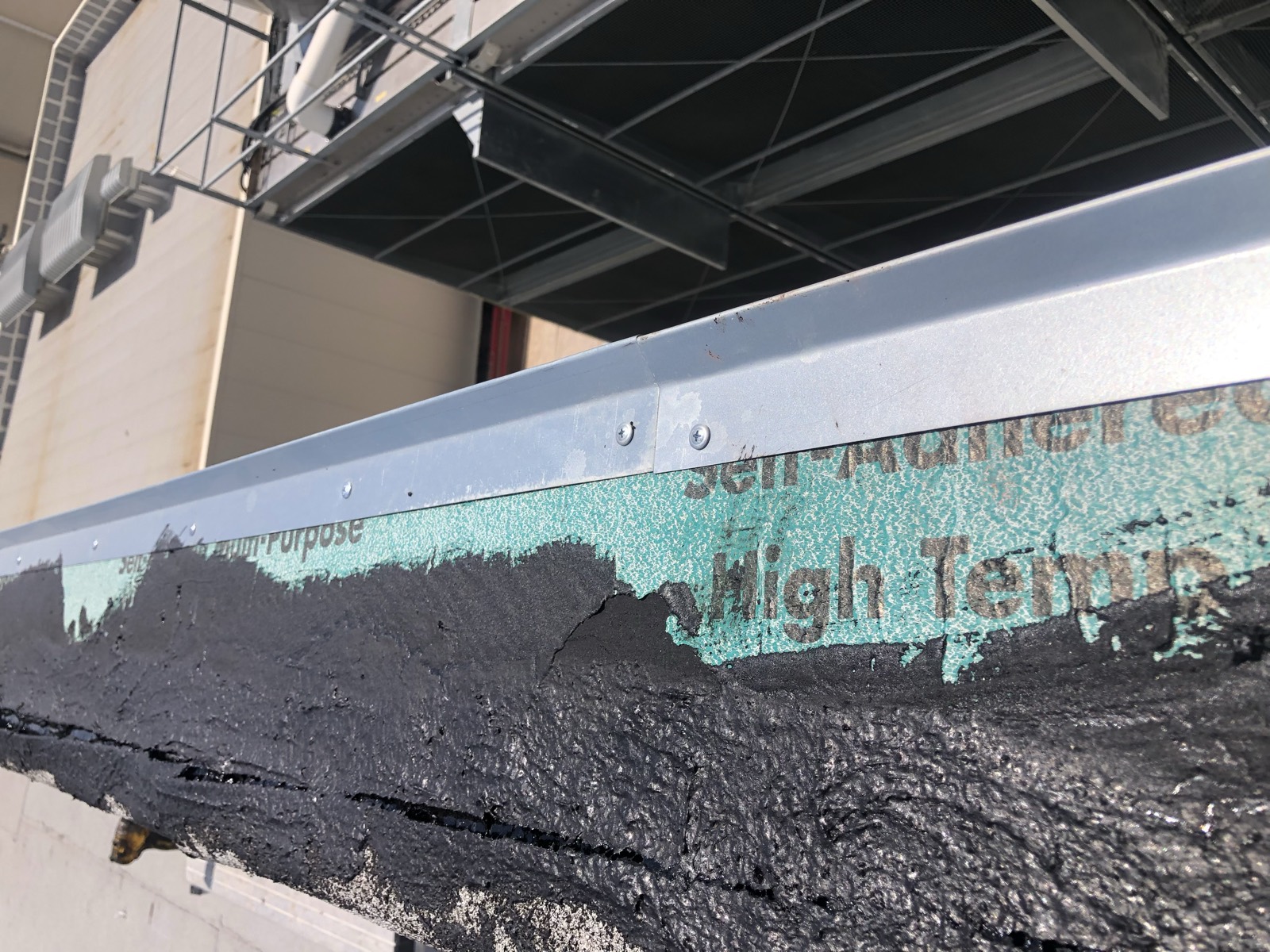
The open field of a low-slope roof rarely fails first. The failures start where something comes through the membrane. Every vent stack, drain, conduit, gas line, exhaust fan, and HVAC curb is a hole in a waterproof surface that has been sealed back up with a detail, and details are what age out.
Rooftop HVAC curbs are the usual culprit. A unit gets serviced, replaced, or re-tied over the years, and each visit is a chance for curb flashing to get cut, lifted, or resealed badly by somebody whose actual job was the compressor. Add Central Texas hail into the picture and it gets worse, because a storm that leaves the field membrane intact can still crack curb flashing, split coil guards, and tear duct wrap. Plenty of the roof damage we document started as a call about air conditioning, not about water.
So we inspect the details on their own terms: pitch pans that have shrunk away from the pipe, sealant that has gone chalky and lost its grip, seam laps at a curb corner that never got fully welded, counterflashing that pulled loose from a parapet. Catching a detail early is a short visit. Catching it after the insulation around it has taken on water is a section replacement.
Working Over an Occupied Building
Almost none of the roofs we work on in Hutto are empty underneath. There is a business operating below, a lease that says the space stays usable, and staff or customers who did not sign up to be part of a construction site. So sequencing is part of the scope from the start. We stage material where it will not block a dock door, a fire lane, or a customer entrance, run the loud and disruptive phases around the hours you tell us to protect, and dry the building in at the end of every shift so an overnight storm never turns an open section into an interior loss.
Who we report to shapes the job too. A property manager needs different things from an owner. Managers need scheduling far enough ahead to notify tenants, documentation clean enough to forward without editing, and a written record for the file. Owners are usually weighing capital timing and want the honest read on how many years are left. We work either way, and we say the same thing to both, but the paperwork is built for whoever is holding it.
That documentation is worth more than it looks. Photos, condition notes, spec, and the dates work was performed become the file you reach for at lease renewal, at a capital budget meeting, or when a manufacturer wants proof the roof was maintained before honoring coverage. We would rather be the company you call again in ten years than the one that got paid fastest this month, and on commercial work that means the record matches what actually happened up there. Call (432) 288-5562 or use our contact page. The broader service overview lives on our commercial roofing page, and finished work is on our project gallery. For everything else we handle in town, start at roofing in Hutto, then see metal roofing, storm restoration, gutter replacement, and shingle roof repair.
Hutto Commercial Roofing FAQ
How do I know whether my low-slope roof needs repair or replacement?
It comes down to what is under the membrane. If the insulation is dry, the deck is sound, and the problems are at seams and details, repair is the right call and it can buy years. If the insulation is saturated across a wide area or the deck has begun to go, patching the top only hides it. We probe suspect areas and check moisture before we recommend either one.
Why does the leak inside my building not line up with anything on the roof?
Because water travels sideways on a low-slope roof. It gets past a seam or a flashing, spreads through the insulation, and drops through wherever it finds a fastener hole or a deck joint. That can be a long way from the actual breach. It is why we trace the path from above instead of working backward from the ceiling stain.
Will my business have to close while you work?
No. We schedule around the hours you need protected, stage materials clear of docks, fire lanes, and customer entrances, and dry the building in before we leave each day. If you have tenants to notify, tell us and we will get you the schedule early enough to send it out.
Do you work with property managers as well as owners?
Yes, and the reporting differs. Managers usually need scheduling with enough lead time to notify tenants plus documentation clean enough to forward as is. Owners are generally weighing capital timing and want a straight read on remaining service life. The recommendation is the same either way, the paperwork is built for whoever holds it.
How often should a commercial roof in Hutto be inspected?
Twice a year is the sensible rhythm, once ahead of spring storm season and once after summer heat has worked on the seams. Get up there after any significant hail or high wind regardless of the calendar. Call (432) 288-5562 to get on the schedule.
Does hail damage a flat roof even when I cannot see a hole?
It can. Hail bruises the membrane and the insulation beneath it without punching through, which weakens the assembly while the roof still looks intact from the parking lot. Rooftop equipment often shows it first, with bent fins and cracked curb flashing. We photograph the details and the field so the record is there if a claim follows.
Commercial Roofing in Hutto
Licensed, OSHA-certified. Low-slope membrane, drainage correction, curb and flashing detail, leak investigation, and scheduled maintenance for Hutto businesses. Every job carries our lifetime workmanship warranty with six years of annual weatherproofing included. Get on the roof before the next storm decides the timeline for you.