Storm-Damage Roof Restoration for Hutto
After Central Texas hail or a hard wind, the first question is whether your roof actually took damage. We climb it, document what is there in dated photographs, cover anything letting water in, and rebuild what needs rebuilding. Lifetime workmanship warranty. Six years of weatherproofing included.
Hail Country, and Hutto Sits Right In It
Hutto sits northeast of Austin along US-79, on open Williamson County ground where a storm arriving from the northwest has very little in its way before it reaches your roof. That geography is the whole story. Central Texas runs a hail and wind season most springs, and a town without much tree cover or elevation between it and the weather takes the stones at full speed rather than glancing. What lands on Star Ranch may skip the old town core entirely, and the reverse happens just as often, because a hail core can be a few blocks wide and stop as abruptly as it started.
The building stock makes the second half of the difference. Hutto has grown fast, so you have new subdivisions where entire streets went up inside a couple of seasons under the same shingle from the same production run, and you have older homes near the center of town that have been standing through storms for decades. A single event ages a new street all at once and finishes off an old roof that was already close to done. Both outcomes look identical from the driveway, which is why the driveway is a bad place to decide anything.
Bruising, Blistering, and Plain Old Age
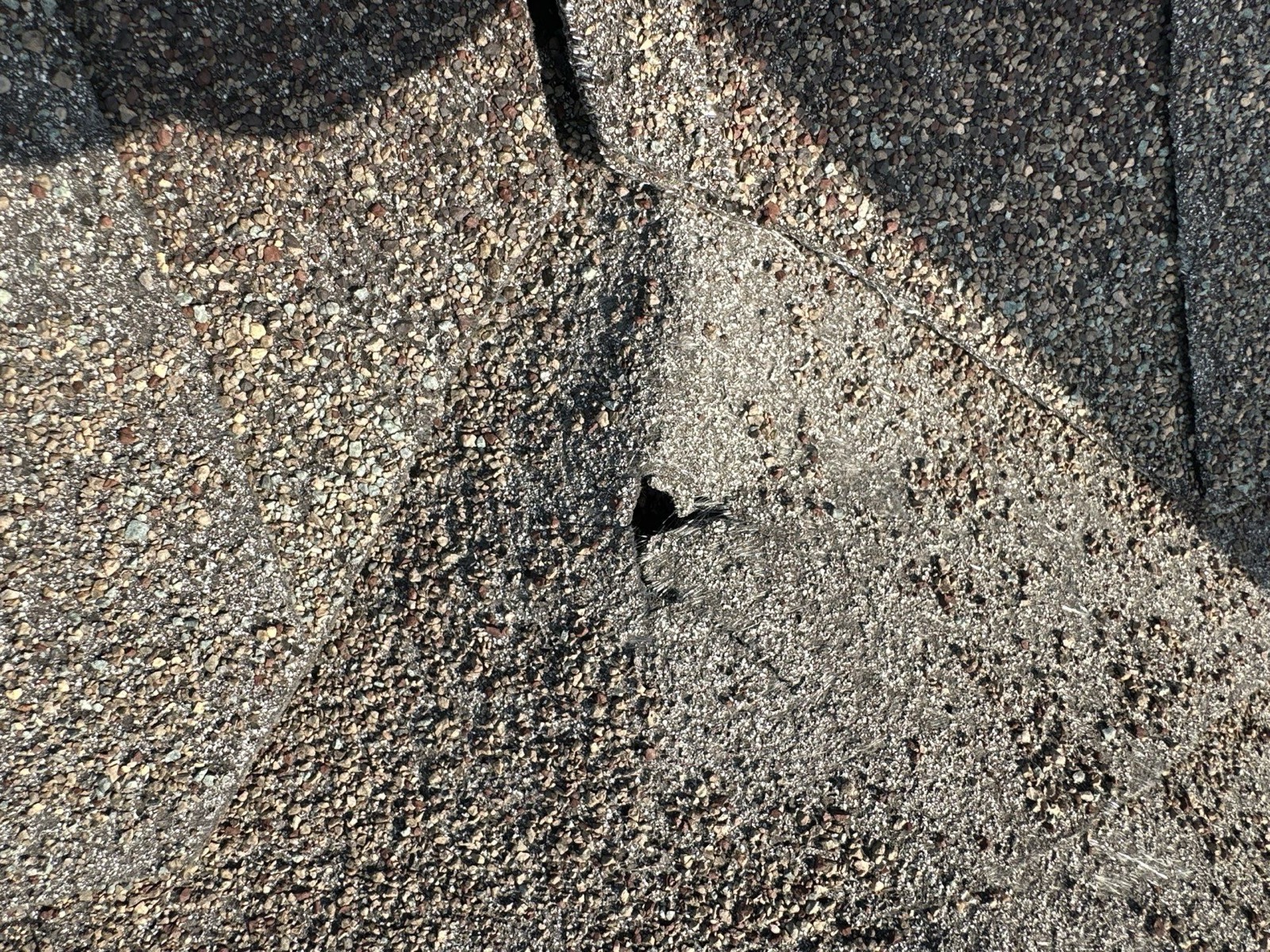
Not every bare spot on a shingle is hail. That is the single most useful thing a Hutto homeowner can know, and it cuts in both directions. Real hail bruising is a soft, roughly round impact where the granules have been driven off and the asphalt mat underneath has been dented. Press a thumb into it and it gives slightly, the way a bruise on fruit does. Blistering is different: small popped bubbles from moisture or heat working out of the mat, usually scattered without any pattern and with sharp little craters instead of a dent. Ordinary granule loss from age is broader and more even, heaviest in the water paths and around the drip edge, and it does not dent anything.
Wind leaves its own signature and it is easier to read once you know it. Look along the ridges, the rakes, and the first course above the eaves, because those are the edges a gust gets under. A wind-creased shingle has a hard fold line across it where it was lifted and slapped back down, and the sealant strip below it is broken even though the shingle is still lying flat and still looks fine from the ground. That crease is the failure. Water tracks along it, and the shingle no longer seals down the way it was engineered to.
Reading which of those four things you have is the entire job of an inspection, and it is why the honest answer sometimes is that the roof is fine and the granules in your gutter are just a roof getting older.
Documenting What Is Actually Up There
The record matters as much as the finding, so we build it carefully. Every impact we identify gets photographed with the date on it, we shoot each slope separately so it is clear where each photo came from, and we mark off test areas rather than hunting for the one dramatic close-up. A marked area showing how many impacts sit inside it tells you something real about the density of damage across that slope. A single striking photo of one bruise tells you almost nothing, and anyone who leans on it is selling rather than inspecting.
We check the soft metals in the same pass, because they corroborate everything else. Vents, pipe boots, drip edge, and gutter faces are thin metal, so they dent when the shingles bruise, and unlike a shingle a dent in a gutter is plainly visible in a photograph. If your gutters and vents show clean strikes, that is straightforward evidence hail of a real size fell on your address and not two streets over.
- Dated photographs. Every impact recorded with the date, organized slope by slope.
- Marked test areas. Impact density measured, not one flattering close-up.
- Soft metal check. Vents, boots, drip edge, and gutter faces confirm what fell here.
- Attic pass. Staining, daylight, and fresh moisture at the decking.
Stopping Water Before Anything Else
If wind opened a slope or a limb came through, none of the rest of this matters until the water stops. Every rain after the damage carries more of it inside, and once the insulation is soaked and the drywall is holding moisture the repair grows well past the roof. So we split the job in two on purpose. Covering an active opening is its own step, it happens first, and it happens fast: a real tarp, fastened properly, not a sheet of plastic held down with bricks that peels off in the next gust.
We photograph the opening before we cover it and again after, so there is a clear record of the condition and of the fact that it was addressed promptly. Then everything else can slow down to a sensible pace. Nobody should be signing a restoration contract while they are still picking hail out of the flower beds, and we do not ask anyone to. Protect the building, then decide about the roof, in that order, with a clear head. Nobody here is compensated for talking you into more roof than the building needs.
Working Alongside Your Adjuster
Here is the plain version of how this part works, because homeowners get told a lot of nonsense about it. Your insurance carrier sends an adjuster, that adjuster inspects the roof, and that adjuster decides what the claim covers. We are a roofing company. We do not make that decision, we do not speak for you to your carrier, and anyone who promises you an outcome before the inspection has even happened is promising something they cannot deliver.
What we do is be present and be useful. We are on the roof during that inspection with our dated photographs and our marked test areas, so the conversation is about the actual condition of the actual slopes rather than a fast walk-around under time pressure. Adjusters are covering a lot of homes after a regional event and they move quickly. Having someone up there who already knows the back slope took the worst of it means the back slope gets looked at.
And the answer is not always yes. Plenty of storms drop hail that is real, loud, and alarming, and leaves a roof with no functional damage at all. Cosmetic marking that does not compromise how the roof sheds water is not the same as damage that shortens its life. When that is what we find, we say so, and you have lost nothing but an hour. If the roof came through sound, you owe us nothing for the look.
The Plenox Approach in Hutto
Hutto is in Williamson County, which is our own county, so this is regular ground rather than a job we drive out for and forget about. We stay on it from the first look through completion and come back to weatherproof the roof once a year for six years afterward. Every restoration carries our lifetime workmanship warranty. See our Hutto roofing page, our shingle roof repair, metal roofing, gutter replacement and commercial roofing work in town, how we approach storm restoration generally, or finished roofs in our project gallery. Call (432) 288-5562 or reach us through our contact page for a free roof review.
Hutto Storm Restoration FAQ
How can I tell hail bruising from ordinary granule loss?
A hail bruise is roughly round, has the granules driven off the center, and dents the mat underneath so it gives slightly under a thumb. Age-related granule loss is broader and more even, concentrated in the water paths and along the drip edge, and it dents nothing.
My roof looks completely fine from the yard. Is it worth a look?
Usually yes. Knocked-loose granules and the mat under them are both dark gray, so bruising barely reads from the ground. The slope facing away from the street often takes the worst of a slanting storm, and that is the slope nobody ever looks at.
Do you cover an active leak right away?
Yes, and it is the first thing we do. We fasten a real tarp over the opening and photograph it before and after, because every rain that follows drives water further into the insulation and drywall. Call (432) 288-5562.
Who decides whether my claim covers the roof?
Your insurance carrier’s adjuster does. They inspect the roof and they write what the claim covers. We are a roofing company, so we are up there with our dated photographs and marked test areas, and that is where our part of it ends.
Does every hailstorm mean a new roof?
No, and we will tell you when it does not. Hail can be loud and alarming and still leave nothing that shortens the roof’s life. Cosmetic marking is not the same as functional damage. If yours came through sound, we say so and you owe us nothing for the look.
Can you match the shingles on a partial repair?
Sometimes. Shingle lines get discontinued, color drifts between production runs, and Texas sun has already faded what is on your roof. If a reasonable match is not available we tell you before we start rather than after.
Storm Restoration for Hutto
We climb the roof, document every slope with dated photographs, cover anything letting water in, and give you a straight answer about whether there is real damage up there. Sometimes that answer is that your roof is fine, and that costs you nothing. When it is not fine, we rebuild it under a lifetime workmanship warranty with six years of weatherproofing included. Hutto is in our home county, so we are still reachable long after the job wraps.