Shingle Roof Repair in Hutto
Hail came through, the ridge lost a course, or a brown ring showed up on the ceiling and nobody can tell you why. Plenox Solutions gets on the roof, finds what is actually wrong, and repairs that. Every repair carries the same lifetime workmanship warranty we put on a full roof.
Two Kinds Of Roof Live In This Town
Hutto grew fast, and it grew in layers. Along US 79 and out through the newer sections there are whole neighborhoods that went up inside a few building seasons, so the shingles on those streets are all the same product, installed by the same handful of crews, and they hit the same age in the same year. Closer to the older heart of town the stock is mixed. Some of those homes have been re-roofed twice, and what is under the top course only reveals itself when we open a section.
That split changes how we approach a repair call. On a newer subdivision roof the field shingles usually still have plenty of life, and the trouble is concentrated at one detail, which makes a targeted repair the obvious answer. On an older mixed-history roof we are more careful, because a previous crew may have left an unusual layer arrangement, an odd flashing choice, or a nail pattern that will fight us. We check before we commit to a plan rather than quoting a fix from the driveway and discovering the truth halfway through the afternoon. Either way you get a full Plenox crew, licensed and insured, not a referral to somebody we met once.
Reading Hail Honestly
Central Texas hail comes through this stretch of Williamson County often enough that most Hutto homeowners have seen at least one storm worth worrying about. The problem is that hail damage is genuinely hard to read, and that ambiguity is where a lot of homeowners get taken. There are two different things people call hail damage and they matter differently.
Granule loss is cosmetic wear. Some of the protective surface has been knocked off, the shingle looks scuffed, and it will age a little faster on that slope. It is real, but on its own it is often not a reason to touch the roof.
Bruising is the one that counts. A stone hits hard enough to fracture the mat underneath without breaking the surface open, so from the ground it looks like nothing at all. Press on it and it gives, like a soft spot on a piece of fruit. That fracture is where the roof will fail later, and a slope with real bruising across it is on a shortened clock no matter how fine it looks from the street. We go up, mark what we find, photograph it, and show you. If it is granule loss and nothing more, we will tell you that too, even though it means a smaller job. Our project gallery shows what the work looks like when it is finished.
Where Wind Takes A Roof Apart
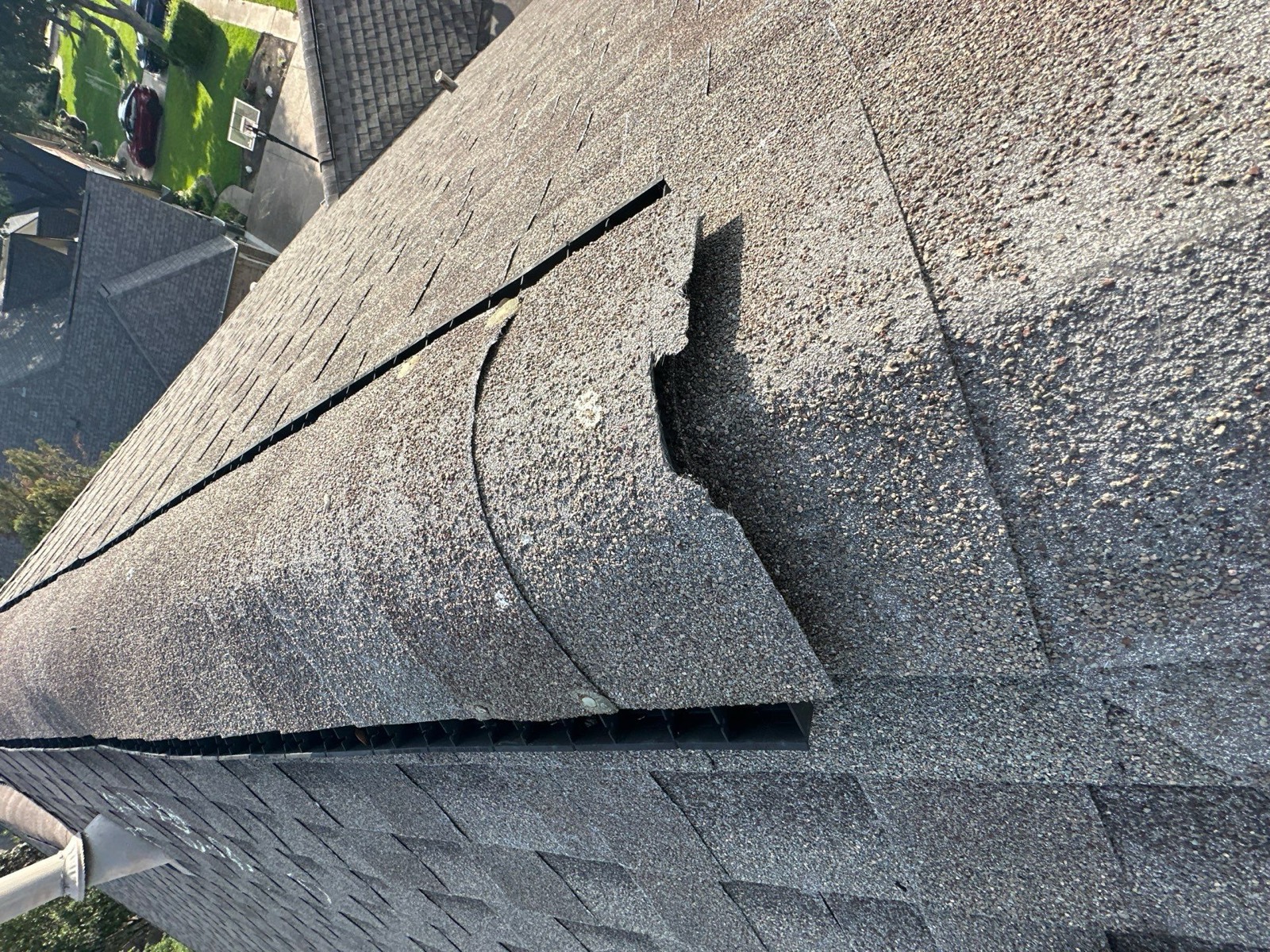
Wind does not usually start in the middle of a slope. It starts at the edges, and on a Hutto roof that means the ridge and the rakes, because those are the lines where air gets underneath. There is open ground around a lot of this area and not much to break a storm line up before it arrives, so gusts arrive with their full force intact and go looking for the first course that is not holding.
The failure runs in a sequence. A gust breaks the seal strip that bonds one shingle to the one below it. That tab is now loose, so the next gust gets further under it and lifts a whole run along the line. Once a section folds back, the layer underneath is exposed, and any rain after that is landing on material that was never meant to face weather directly. That is why an obviously damaged ridge is urgent in a way a scuffed slope is not. Water on open decking turns a shingle problem into a wood problem in one storm, and a wood problem costs considerably more to put right. If a whole storm event hit your property rather than one section of roof, our storm restoration page covers that side of the work.
Heat, And Why One Slope Ages Faster
Stand across the street from almost any home here and one face of the roof will look years further along than the rest. That is the sun doing exactly what it does to asphalt every summer. Shingles on the south and west slopes take direct heat for hours a day through the long Texas warm season, and heat drives out the oils that keep the mat flexible. Then the temperature drops overnight and everything contracts. Repeat that cycle through enough summers and the shingle goes stiff, stops laying flat, stops sealing well, and starts shedding granules whenever it is disturbed.
The practical result is that a stiff slope is the slope that fails when weather comes. The wind that lifts nothing on your shaded north face will take a run of tabs off the west one, and hail that leaves a supple shingle merely scuffed will fracture a brittle one. This is also why attic ventilation is worth a look while we are up there. When heat is trapped against the underside of the deck all day, the shingles cook from both directions, and the roof loses years it should have had. We are Lomanco certified in ventilation design, so we check the intake and exhaust on every repair call and tell you if airflow is part of why the same slope keeps giving you trouble.
Finding The Leak, Then Deciding What It Deserves
Water enters at one point and appears somewhere else entirely. It gets through a boot, a valley, or a flashing line, runs along a rafter or the top of the ceiling until it meets something that stops it, and drips there. So the stain on your ceiling is a clue about where to start, not a map of the hole. We work uphill from it, checking the penetrations and the seams and the seal strips until we find the actual entry, and then we photograph the thing itself so you can look at what you are paying to have fixed.
The repair gets done properly. Failed flashing comes off and new metal goes on, because sealant smeared over bad flashing buys a season and then leaks again. Split boots get replaced outright.
Then there is the harder conversation. Repair is the right call when the field shingles still have real life and the damage is in one identifiable place. It is the wrong call when the roof is near the end of its run anyway. If the granules are already collecting in your gutters, if the shingles crack when a boot touches them, if the trouble shows up on several slopes at once, then every repair is money spent on something that needs replacing regardless. We turn down work we cannot stand behind, which costs us jobs and keeps the phone ringing later, so we will say that plainly even when the repair is the easier sale. Leander is a short drive west, which makes Hutto normal territory for us. If the answer turns out to be a full roof, start at our Hutto roofing page or the site-wide shingle roof repair page. Considering a different material next time, see metal roofing. Water spilling over the edge instead of through the roof usually means gutter replacement, and for a shop or building rather than a house, see commercial roofing. Call (432) 288-5562 or reach us through our contact page.
Hutto Shingle Repair Questions
How do I know if hail actually hurt my roof or just scuffed it?
From the ground you cannot, and that is the honest answer. Granule loss looks dramatic and is often cosmetic. Bruising looks like nothing and is the one that shortens the life of the roof, because the mat is fractured underneath a surface that is still intact. It has to be found by hand, on the roof. We go up, press the suspect areas, mark what we find, and photograph it so you are looking at evidence rather than taking our word for it.
The ridge on my roof is peeled back. How urgent is that?
Urgent. Once a run of shingles folds back along the ridge, the layer underneath is facing the weather directly, and that layer was never built for it. One good rain on exposed decking turns a shingle repair into a decking repair, which costs a great deal more. Call as soon as you see it. If we cannot complete the full repair that day we can get temporary protection over the opening so the water stays out until we can.
Will a repair patch match the rest of my shingles?
Sometimes closely, sometimes not. Product lines get discontinued, and even a current shingle will not match a roof that has been fading in Texas sun for fifteen years. We tell you before we start whether the patch will blend or show. On a back slope nobody looks at, close is fine. On the front of the house we will sometimes suggest redoing that whole plane so the roof reads as one roof instead of a patchwork.
My neighbors are all getting new roofs. Should I be worried about mine?
It means their roofs are the same age as yours, which is worth paying attention to, but it is not a diagnosis. Whole streets here went up in one building season, so they reach the same age together. Some of those roofs genuinely need replacing and some have years left with a boot swapped out. We will climb yours and tell you which one you have, rather than pointing at the dumpster next door.
Why does only one side of my roof look bad?
Sun. The south and west slopes take direct heat for hours a day through the long warm season, which drives the oils out of the asphalt and leaves the shingles stiff and shedding granules. A stiff shingle does not seal well and does not flex, so that face is the one wind lifts and hail fractures while the shaded side comes through untouched. Trapped attic heat makes it worse from the underside, which is why we check the ventilation while we are up there.
When is a repair the wrong thing to buy?
When the roof is near the end of its life anyway. If granules are collecting in the gutters, if the shingles crack when they are handled, if damage shows up on several slopes rather than one spot, then a repair is money spent on something that will need replacing regardless. We will say that out loud even though the repair is the easier sale, because we would rather be the roofer you call in ten years than the one who took the quick job.
Have The Hutto Roof Looked At
Straight read, photos you can see for yourself, lifetime warranty on workmanship. Call for a free roof review.